Launch offer — valid today only

📄 Digital book in PDF · read it on your phone or print it

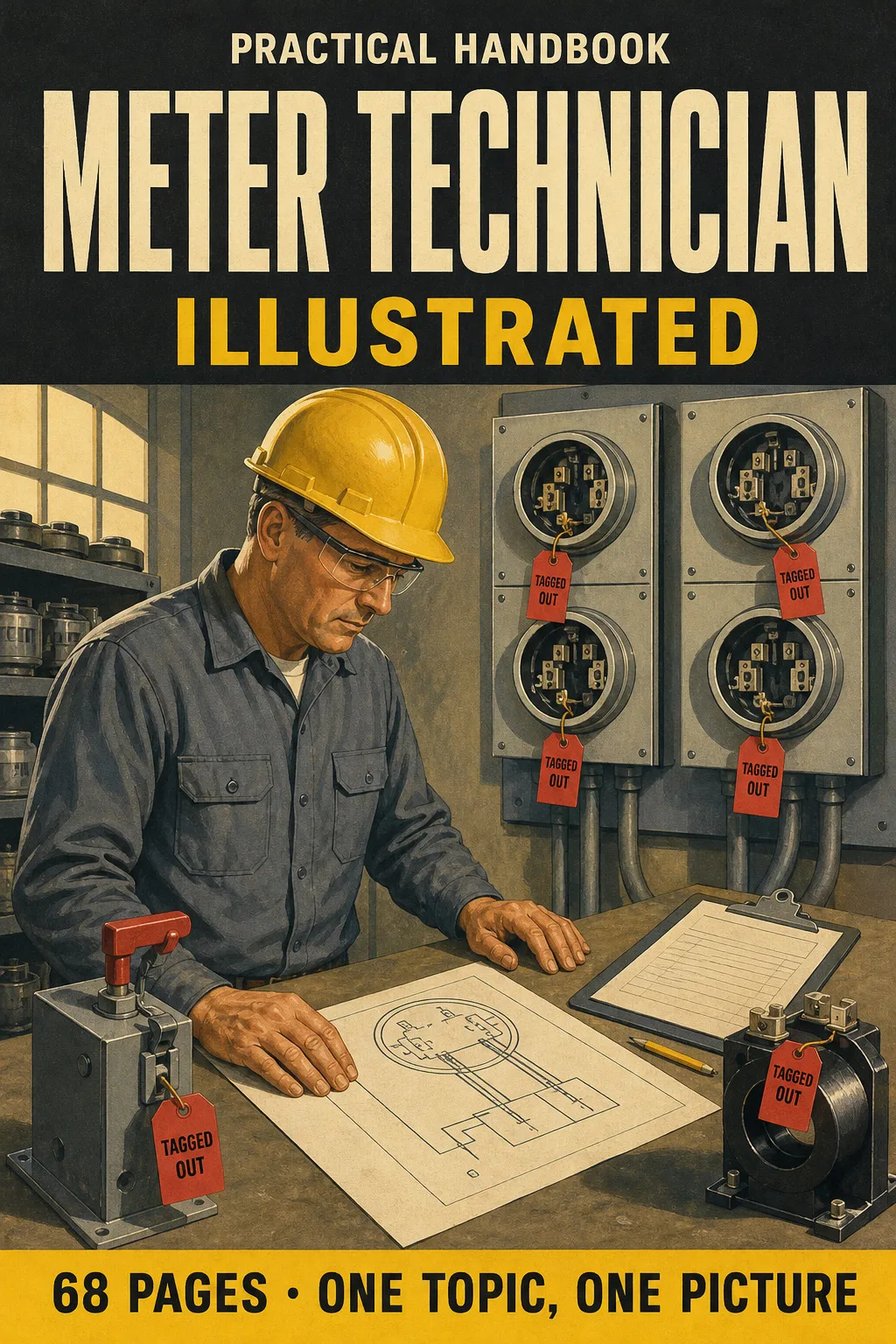
Meter Forms, CTs and Services in Drawings: Read Any Meter Diagram in the Same 5 Steps One Topic on Every Page

Meter elements, self-contained vs transformer-rated, wye and delta services, Forms 2S, 9S and 5S, CT ratios and polarity, test switches, phasors and meter changes. Every topic gets its own page: first the drawing, then what you need to remember. 68 illustrated pages.

I WANT TO STUDY METERING THIS WAY

🔒 Secure checkout · PDF by email · 30-day guarantee

Every topic, its own pageEvery socket, service and ratio drawn, with the explanation right beside it
68 illustrated pages8 parts, from what a meter element is to the checklist before your test and checkoff
Up-to-date sourcesANSI C12 series, NFPA 70E and OSHA 1910.269
PDF by emailFormat

Look Inside the Book

Every page has one big drawing and a box with the numbers, ratios and steps you need to know:

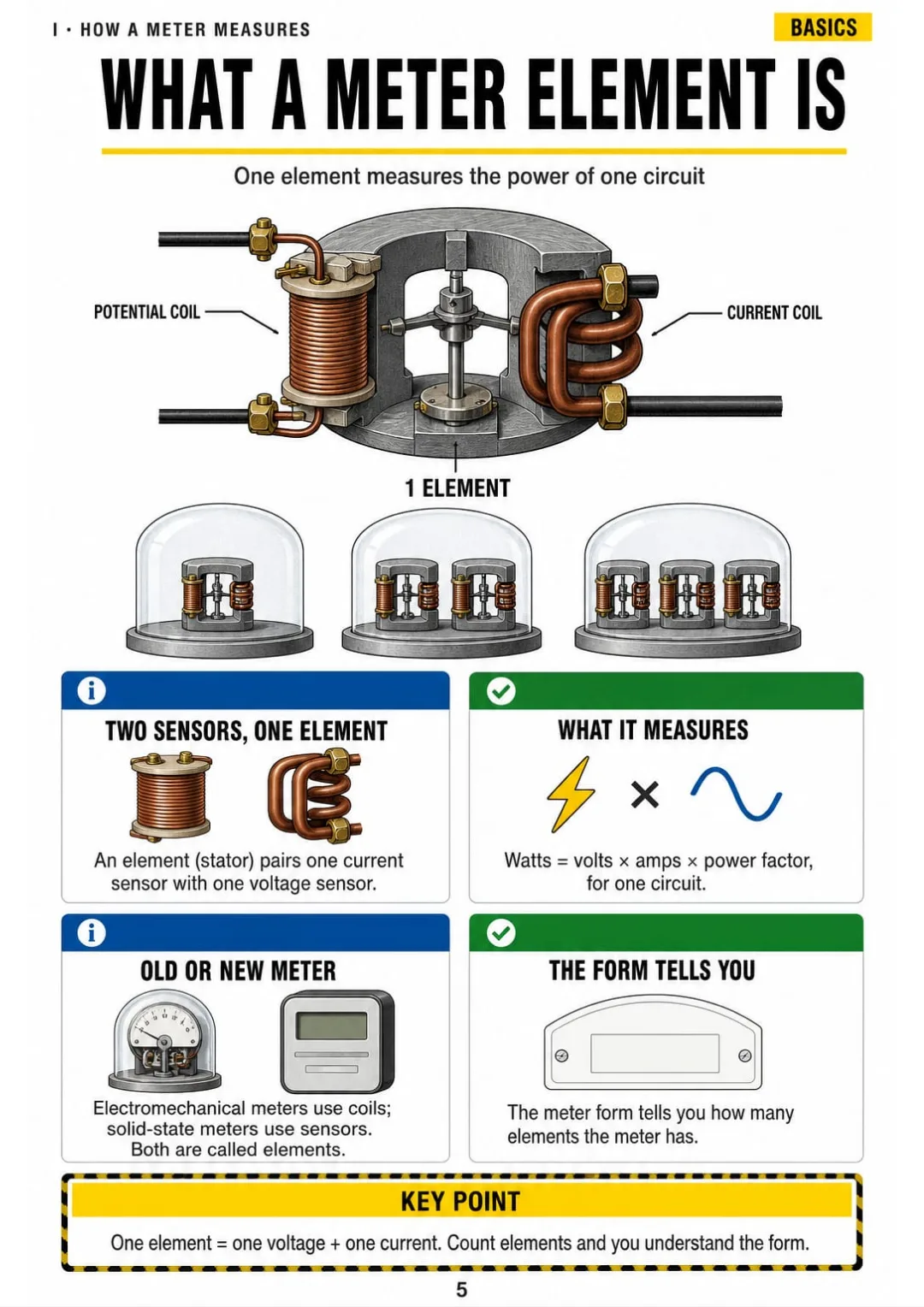
One element pairs one voltage sensor with one current sensor and measures one circuit.
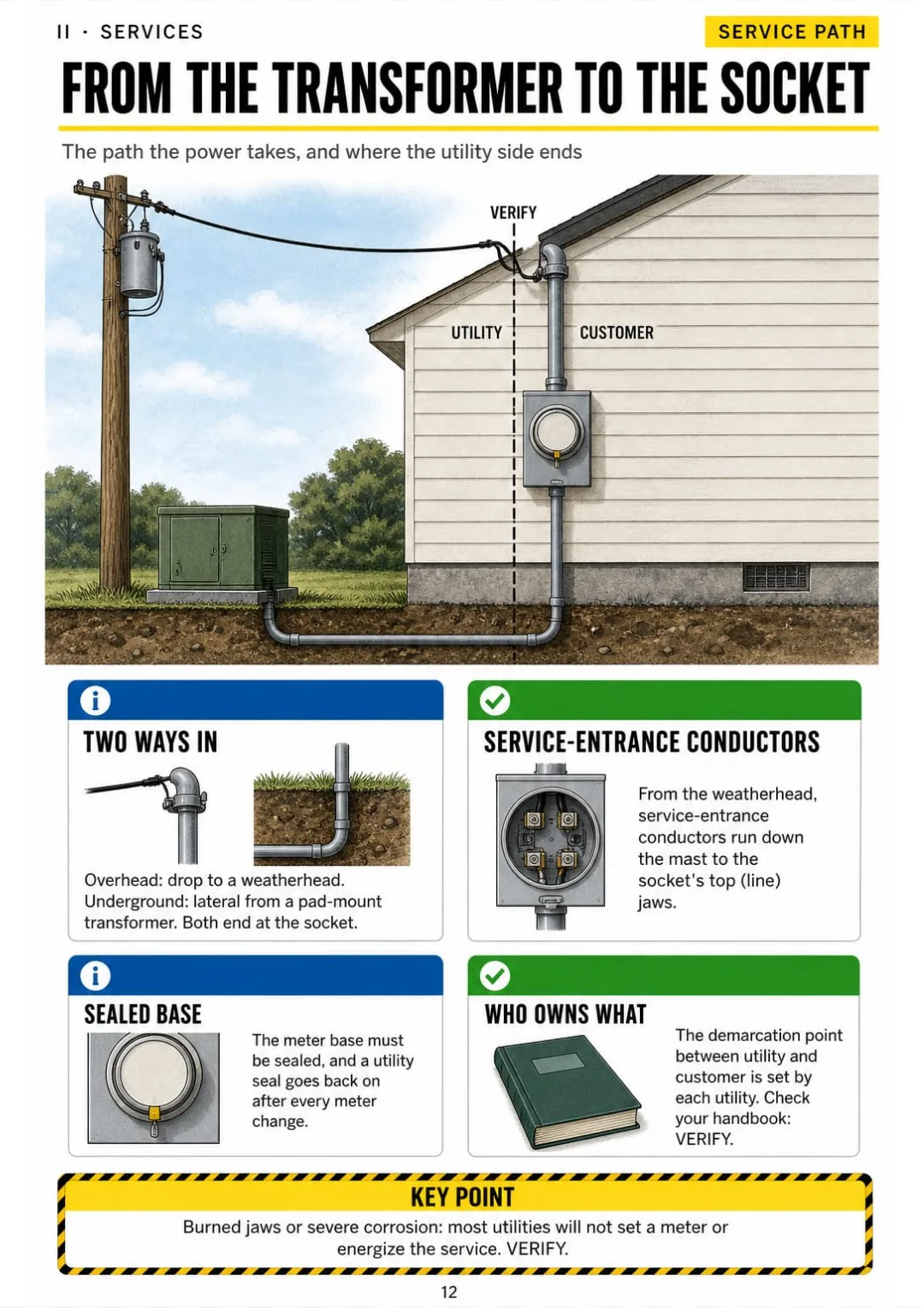
Transformer, drop or lateral, socket, meter, panel: five stops, one dashed line that says VERIFY.
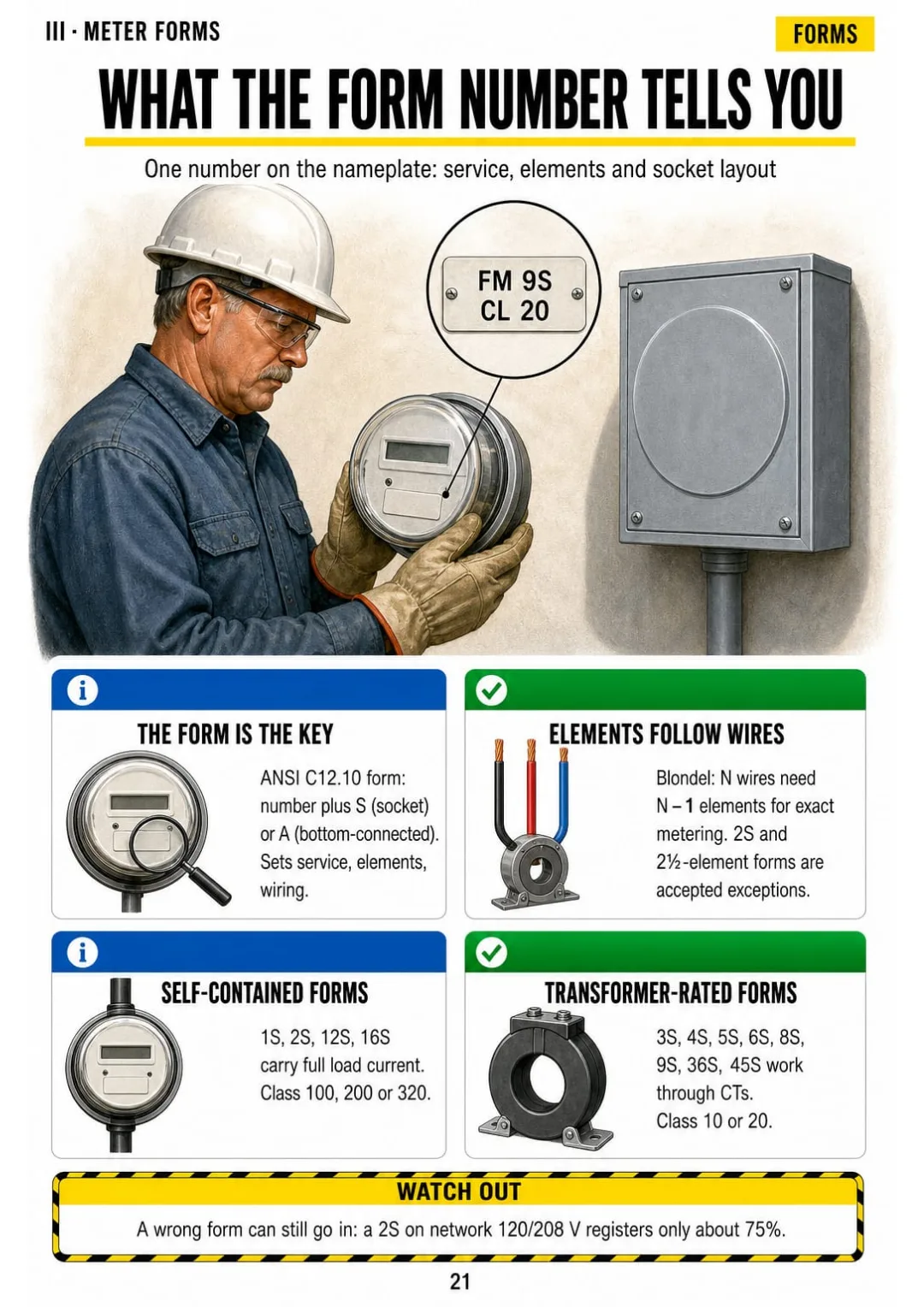
FM 9S on the nameplate = transformer-rated, 3 elements, 4-wire wye
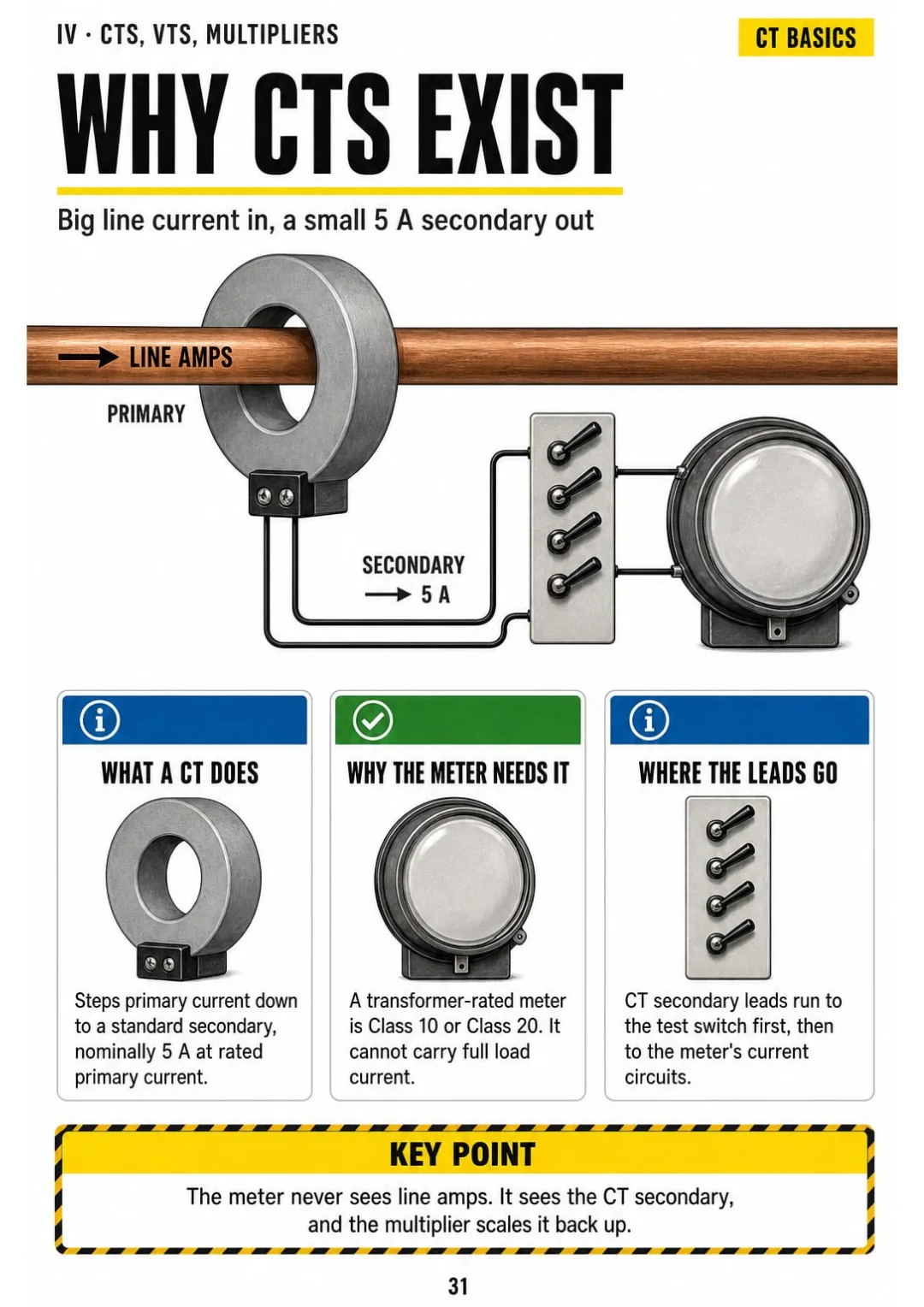
CT secondary: nominally 5 A at rated primary current, so a Class 20 meter can measure big loads.
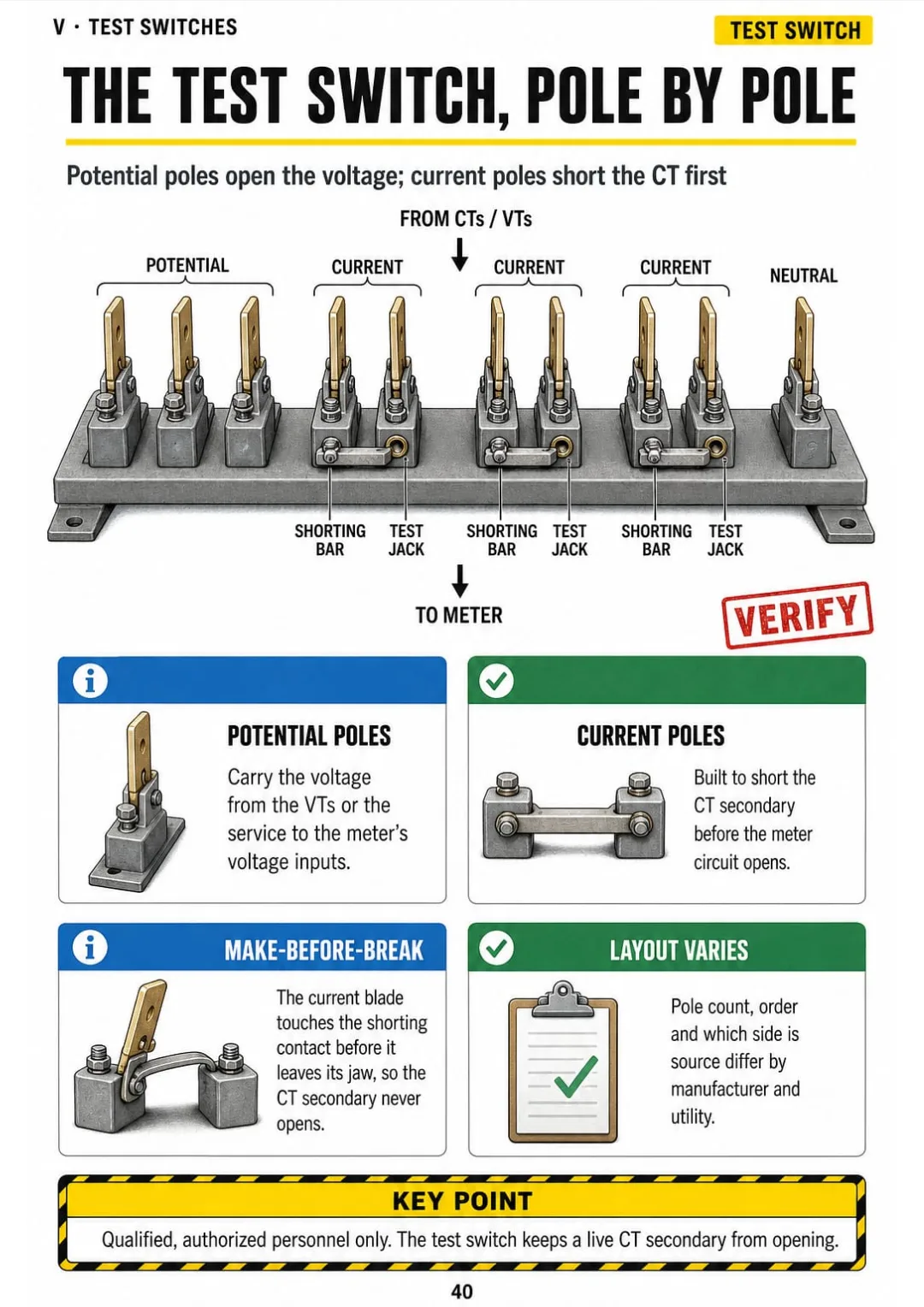
Potential poles vs current poles: current switches short the CT before they open
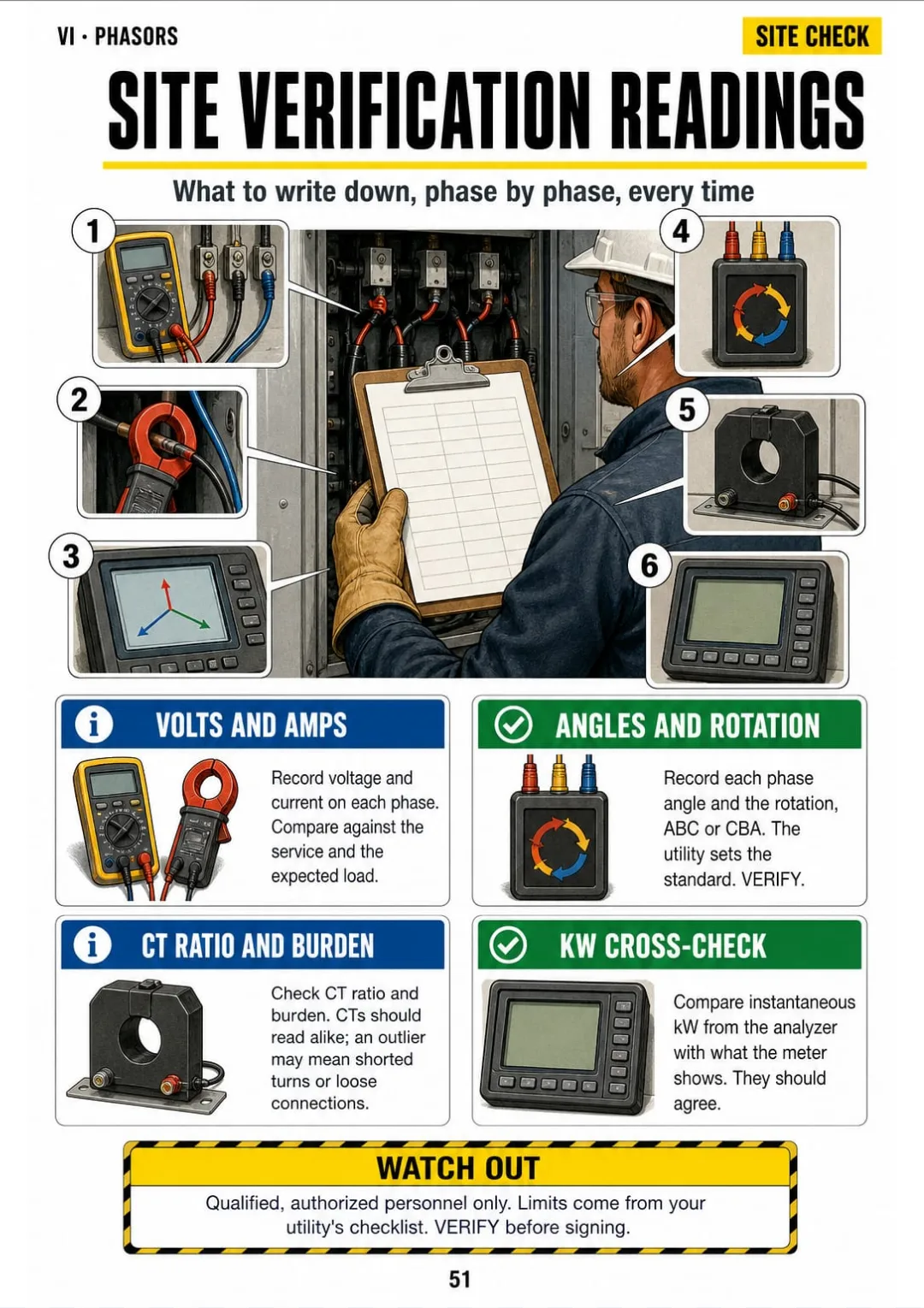
Site check: volts, amps, angles, rotation, CT ratio and burden, kW vs meter
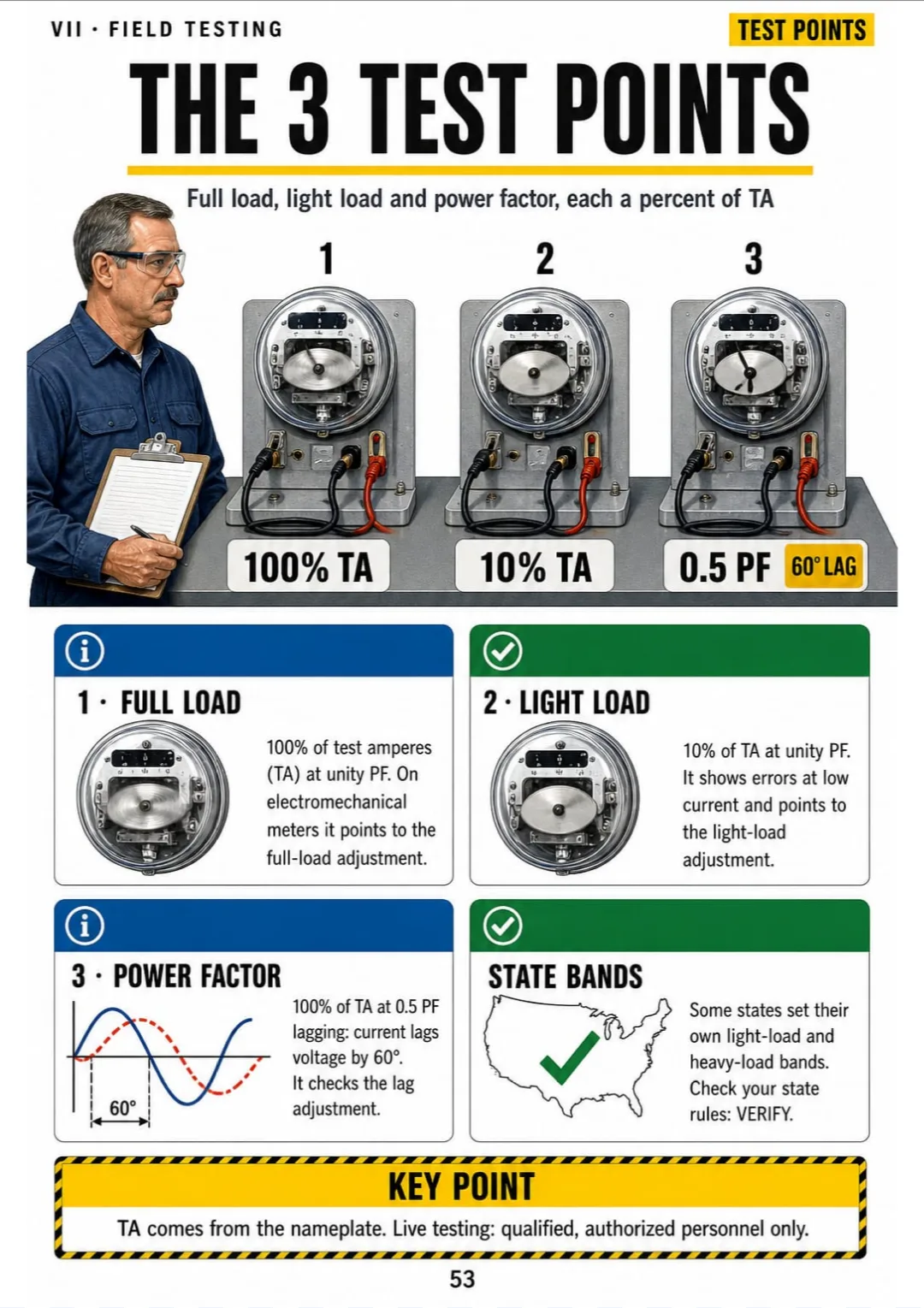
Full load 100% TA · light load 10% TA · PF 100% TA at 0.5 lagging
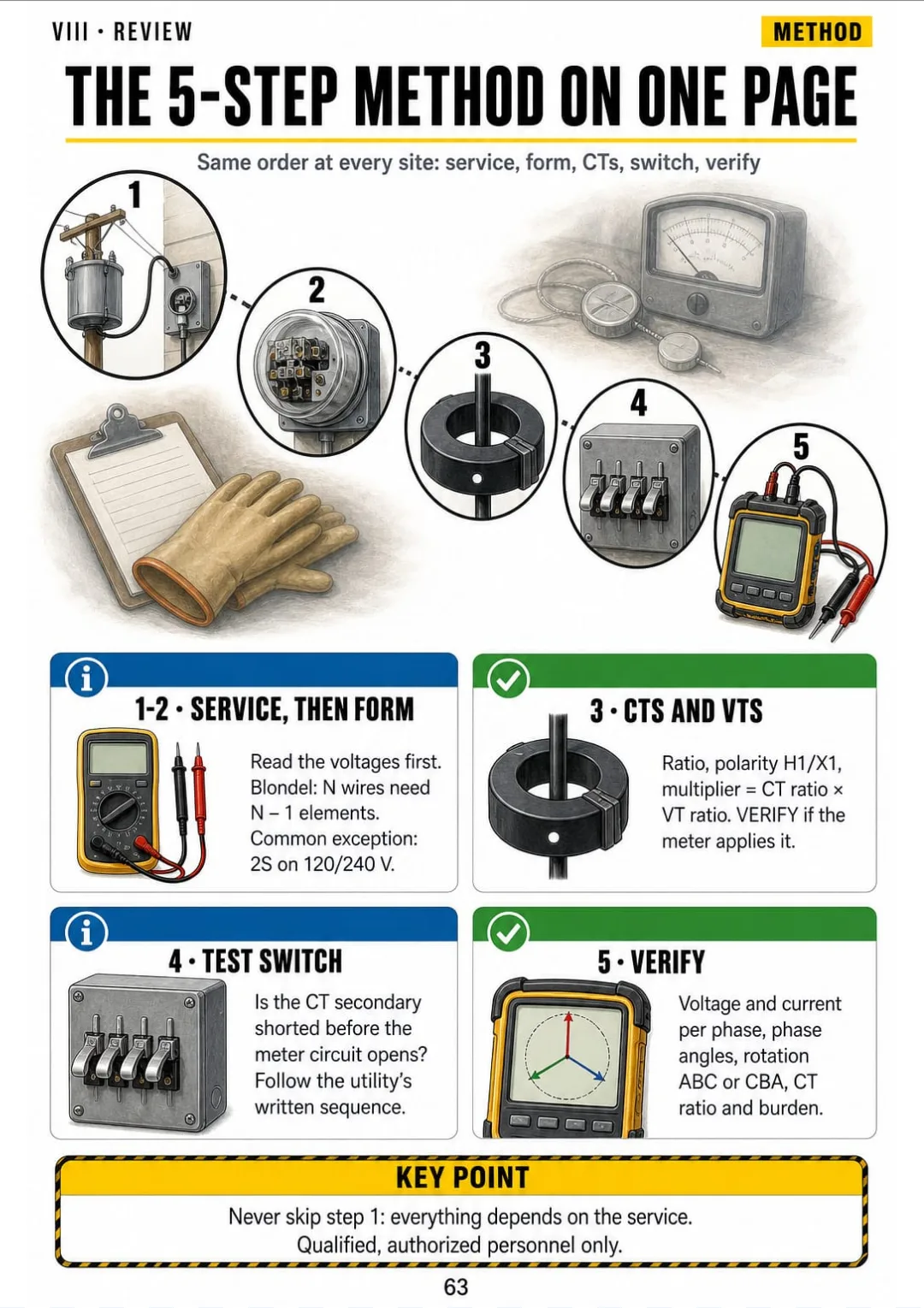
Service → form → CTs and VTs → test switch → verify, with the key question for each

Swipe to see more →

These are real pages from the book. The table of contents is the full one: 8 parts and 64 topics.

The Problem Isn't You. It's How It Was Explained to You.

You're standing at a socket with a new meter in your hand. The nameplate says FM 9S, the journeyman is waiting, and you can't say out loud what that number tells you.

You read it last night. The manual covers meter forms in two pages of paragraphs, with elements, wires and ratings packed into one block. Nothing ties the number to the wiring, so by morning it's gone.

FM 9S on the nameplate = transformer-rated, 3 elements, 4-wire wye

In this book, the form number is one page. FM 9S is drawn right on the nameplate, with an arrow for each thing it means: transformer-rated, 3 elements, 4-wire wye. You know what's behind the glass before you touch the socket.

Same with the rest: Form 2S, Form 5S on a delta service, CT ratio and polarity, the test switch pole by pole, phase rotation. Each one has its own page.

So the next time you read a nameplate, you know the service, the elements and the wiring without going back to the manual.

COMPARE FOR YOURSELF

The Same Topic, Two Ways to Study It

THIS
  • The manual: line after line of text
  • Services and sockets explained only in words
  • You walk into the test still unsure
The electric service shall be understood as the conductors and equipment that deliver energy from the serving utility's distribution transformer to the wiring system of the premises served. Service conductors may be installed overhead, as a service drop, or underground, as a service lateral, and shall terminate at the meter socket enclosure, wherein the line-side conductors are connected to the upper jaws and the load-side conductors to the lower jaws, prior to continuation to the service disconnecting means and panelboard, subject to the utility's specifications.
FOR THIS
  • Transformer to socket in one drawing
  • The five stops in one box
  • You see it and you get it
Transformer, drop or lateral, socket, meter, panel: five stops, one dashed line that says VERIFY.
CONTENTS

Take a Look at the 8 Parts and 64 Topics

How a meter measures, services from transformer to meter, meter forms, CTs, VTs and multipliers, test switches and wiring diagrams, phasors and site verification, testing and field work, and the review checklists: 68 pages, all illustrated.

IHow a Meter Measures · pp. 5-11
  1. What a meter element is
  2. kWh vs kW demand
  3. The watthour constant Kh
  4. Blondel's theorem in one drawing
  5. Reading the meter nameplate
  6. Self-contained vs transformer-rated
  7. Socket anatomy, jaw by jaw
IIServices from Transformer to Meter · pp. 12-20
  1. From the transformer to the socket
  2. Single-phase 2-wire 120 V
  3. Single-phase 3-wire 120/240 V
  4. Network 120/208 V 3-wire
  5. Three-phase 4-wire wye
  6. Three-phase 3-wire delta
  7. 4-wire delta and the high leg
  8. Identify the service with your voltmeter
  9. Phase rotation ABC vs CBA
IIIMeter Forms · pp. 21-30
  1. What the form number tells you
  2. Form 1S
  3. Form 2S
  4. Forms 3S and 4S
  5. Form 12S
  6. Form 16S
  7. Form 5S
  8. Form 9S
  9. Forms 45S and 36S
  10. Choosing the form: the 3 questions
IVCTs, VTs and Multipliers · pp. 31-39
  1. Why CTs exist
  2. CT ratio
  3. CT polarity: H1 and X1
  4. Never open a live CT secondary
  5. CT rating factor
  6. Burden and accuracy class
  7. Voltage transformers (VTs/PTs)
  8. The meter multiplier
  9. Billing kWh with the multiplier
VTest Switches and Wiring Diagrams · pp. 40-46
  1. Test switch layout
  2. Isolating the meter at the test switch
  3. Restoring the meter
  4. Reading any diagram: the 5-step method
  5. Tracing a 9S, terminal by terminal
  6. Tracing a 5S on a delta service
  7. Wire colors and terminal labels
VIPhasors and Site Verification · pp. 47-52
  1. Phasors without fear
  2. Power factor and the power triangle
  3. Wye phasors: 120° apart
  4. Delta phasors and the 30° shift
  5. Site verification readings
  6. How a wiring error looks on phasors
VIITesting and Field Work · pp. 53-62
  1. Full load, light load, power factor
  2. Percent registration
  3. Creep test
  4. Demand intervals and resets
  5. AMI and solid-state meters
  6. PPE and the arc flash label
  7. Self-contained meter change, step by step
  8. Transformer-rated meter change, step by step
  9. Bypass sockets
  10. Tampering and diversion signs
VIIIReview and Field Checklists · pp. 63-68
  1. The 5-step method on one page
  2. Service voltages at a glance
  3. Meter forms at a glance
  4. Formula sheet
  5. The most frequent wiring errors
  6. Before your test and your checkoff

One Page, One Topic, All Clear

Think of it this way:

You're on a transformer-rated job and the work order says to swap the meter. Before anything else, you need to know which test switch poles open, and in what order.

You open the book to the test switch page and see it drawn pole by pole: potential poles on one side, current poles on the other, and the current switches shorting the CT before they open.

Potential poles vs current poles: current switches short the CT before they open

Same with the 4-wire delta high leg, CT polarity H1 and X1, the meter multiplier, wye phasors 120° apart and the creep test: each one on its own page.

Meter Technician Illustrated is 8 parts and 64 topics, all drawn, and at the end the review pages: the 5-step method, service voltages and meter forms at a glance, and the formula sheet.

What you see drawn, you don't have to memorize.

What's Inside Meter Technician Illustrated:

Ipp. 5-11

How a Meter Measures

What a meter element is, kWh vs kW demand, the Kh constant, Blondel's theorem, the nameplate, self-contained vs transformer-rated and the socket jaw by jaw.

IIpp. 12-20

Services from Transformer to Meter

The path from transformer to socket, single-phase 120 V and 120/240 V, network 120/208 V, wye, delta, the high leg, identifying the service with your voltmeter and phase rotation.

IIIpp. 21-30

Meter Forms

Read the form number and know the meter: Forms 1S, 2S, 3S, 4S, 12S, 16S, 5S, 9S, 45S and 36S, each one drawn, plus the 3 questions to pick the right form.

IVpp. 31-39

CTs, VTs and Multipliers

Why CTs exist, CT ratio, polarity H1 and X1, the open-secondary danger, rating factor, burden and accuracy class, VTs, the multiplier and billing kWh.

Vpp. 40-46

Test Switches and Wiring Diagrams

Trace any diagram the same way every time: test switch layout, isolating and restoring the meter, the 5-step method, a 9S and a 5S traced terminal by terminal, and wire colors and labels.

VIpp. 47-52

Phasors and Site Verification

Phasors without fear, power factor and the power triangle, wye at 120°, delta and the 30° shift, site verification readings and how a wiring error looks.

VIIpp. 53-62

Testing and Field Work

Full load, light load and PF tests, percent registration, creep, demand resets, AMI meters, PPE and arc flash labels, meter changes step by step, bypass sockets and tampering signs.

VIIIpp. 63-68

Review and Field Checklists

The 5-step method on one page, service voltages and meter forms at a glance, the formula sheet, the most frequent wiring errors and the checklist before your test and checkoff.

At the end of the book: Review pages at the end: the 5-step method, service voltages, meter forms at a glance, a formula sheet and a pre-test checklist.
Plus: 2 Free Books

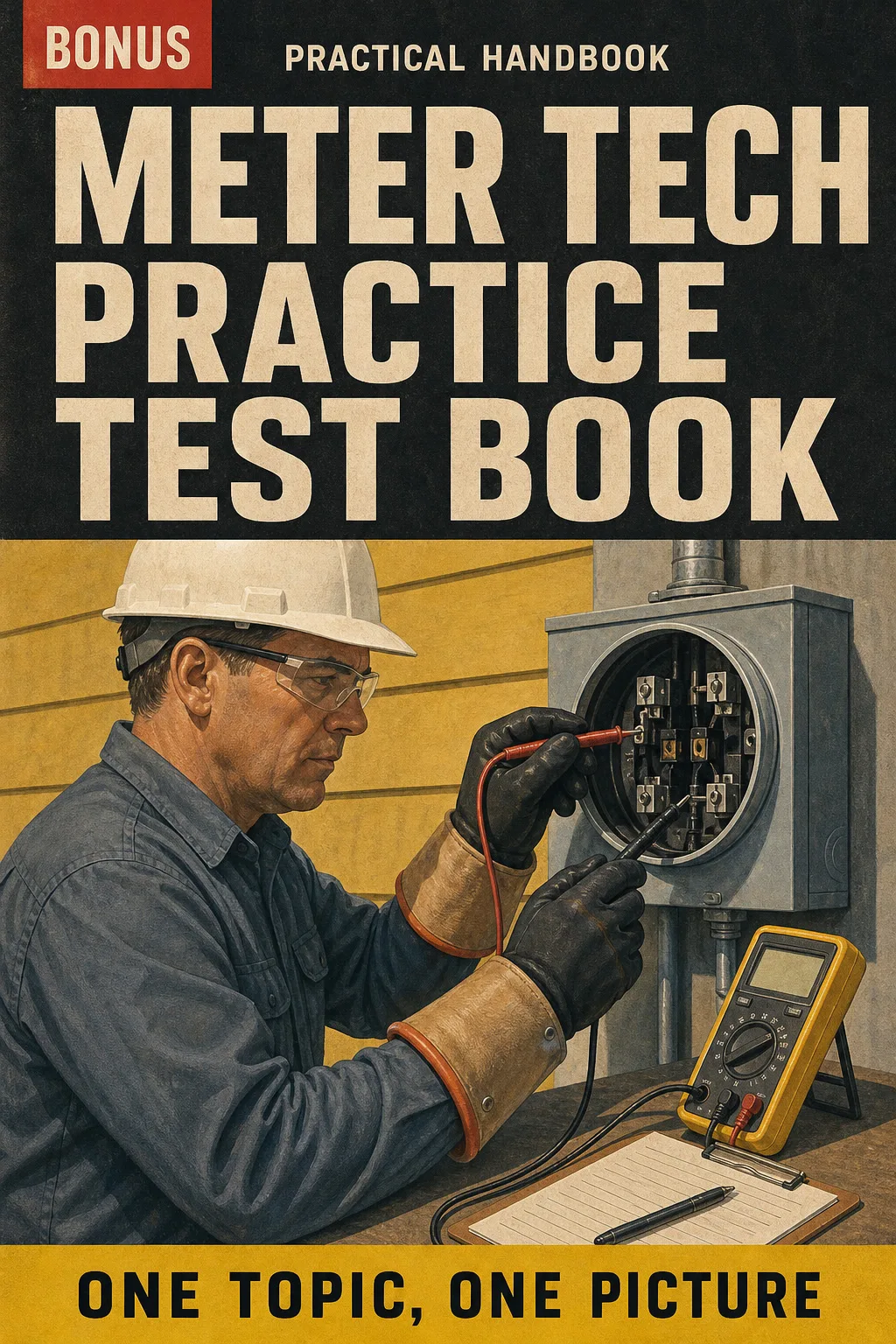
Meter Tech Practice Test Book

BONUS 1: «Meter Tech Practice Test Book»

Value on its own: US$ 17.90

Exam-style questions on forms, services, ratios and test switches, with the answer explained, so you find your weak spots before the test does.

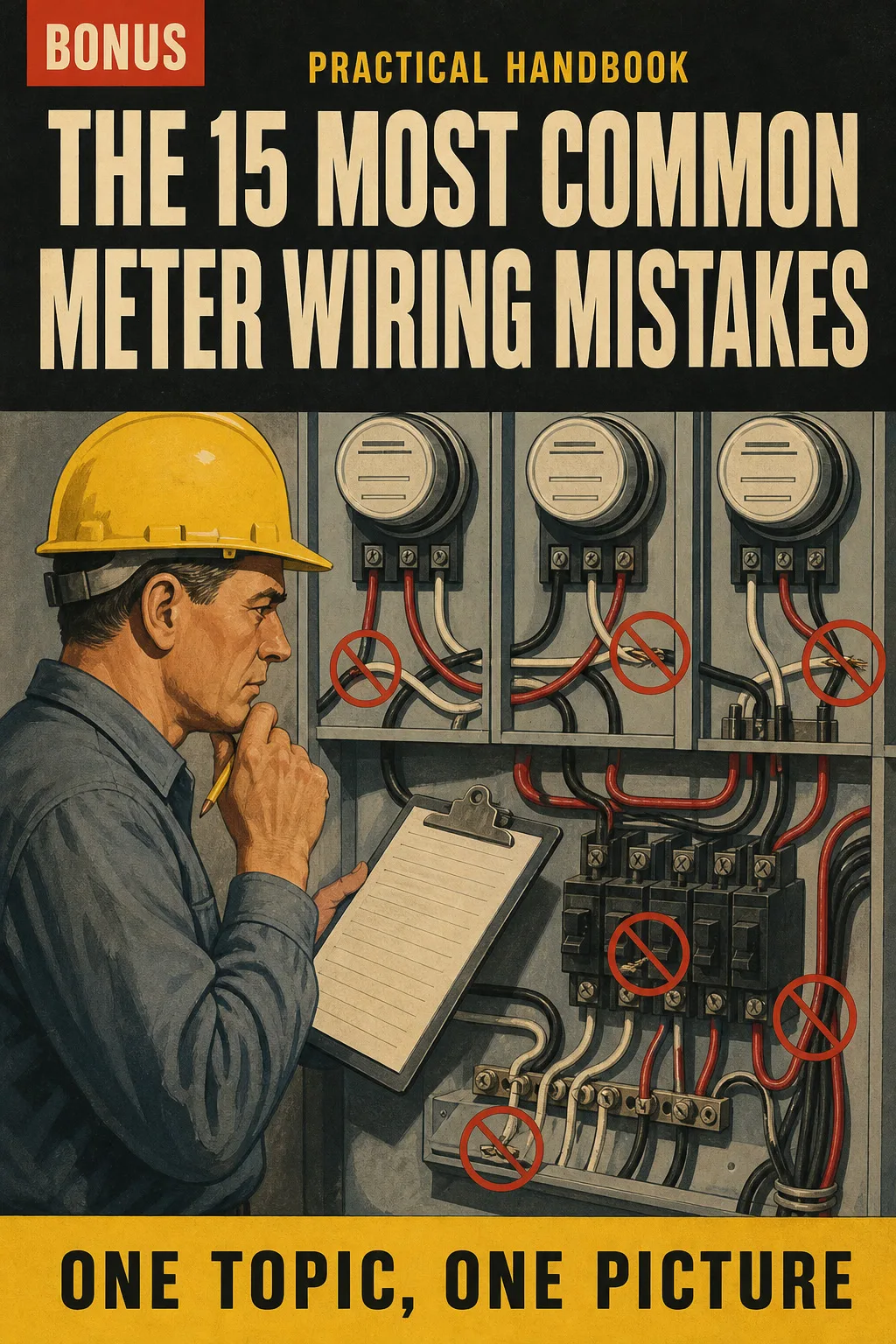
The 15 Most Common Meter Wiring Mistakes

BONUS 2: «The 15 Most Common Meter Wiring Mistakes»

Value on its own: US$ 14.90

Each frequent error drawn before and after, with how it shows up on the meter, so you spot it at the socket instead of after the bill goes out.

Meter Technician Illustrated with 2 Free Books

  • Meter Technician Illustrated: 68 illustrated pagesUS$ 63
  • BONUS 1: Meter Tech Practice Test BookUS$ 17.90
  • BONUS 2: The 15 Most Common Meter Wiring MistakesUS$ 14.90
  • High-resolution PDF to printIncluded
Total value US$ 95.80
YOUR PRICE:
US$ 27
You save US$ 68.80
YES, I WANT METER TECHNICIAN ILLUSTRATED FOR US$ 27

📄 This is a digital PDF book sent to your email: nothing is printed or shipped.

Secure purchaseEncrypted payment30-day guarantee

PDF by email: We email you Meter Technician Illustrated as a PDF, together with the two free books. It's a single payment: no installments, no extra charges.

Who This Book Is For

You're in the apprenticeship program

You're in the apprenticeship program

Every form, service and ratio in the same order, one page each, so what you study at night is still there the next morning.

Your meter tech test is coming up

Your meter tech test is coming up

The review pages and the practice test book show you where you're weak, while there's still time to go back to that page.

You already work in the field

You already work in the field

A printable reference for the truck: the socket, the test switch and the 5-step method to check against your utility's procedure.

Everything You Get Today

US$ 95.80US$ 27
YES, I WANT METER TECHNICIAN ILLUSTRATED FOR US$ 27

📄 This is a digital PDF book sent to your email: nothing is printed or shipped.

30DAYS
GUARANTEE

30-Day Guarantee

Try Meter Technician Illustrated for 30 days, bonus books included.

We refund everything if the file won't open, if the book isn't what you see here, if you were charged twice or if the email doesn't arrive. Just email us.

You pay once. No subscriptions.

Frequently Asked Questions

Is this for me if I already work with electricity and I'm moving into metering?

Yes. It's written for lineworkers, meter readers, electricians and apprentices who already know basic electricity, so it doesn't start at Ohm's law: it starts at the meter element and goes to transformer-rated services, ratios, test switches and phasors. Each utility and apprenticeship program writes its own test and procedures. The book covers what they share across the U.S. (ANSI C12 meter forms, NEC service equipment, CT and VT basics), and every page that depends on your utility's rules is marked VERIFY, so you check it against your own manual.

Where does the content come from?

From the ANSI C12.1 and C12.10 meter form designations, the NEC (NFPA 70) for service equipment, and NFPA 70E and OSHA 29 CFR 1910.269 for safety. Every page that depends on a utility rule is marked VERIFY.

Is this official material?

No. It's independent study material, not affiliated with or endorsed by any utility, cooperative, union, standards body or exam provider. It doesn't give you a certificate or count as program hours: it's for studying and reviewing before your test and your checkoffs.

Does it replace my apprenticeship training or my utility's procedures?

No. It helps you study and review. Your training, your utility's metering and meter change procedures and its safety rules always come first, and energized work is for qualified and authorized personnel only.

Are the practice questions the ones on the test?

No. They're exam-style questions written for this book, with the answer explained. They're not official questions from any test.

When and how do I get it?

The book and the 2 bonus books come as PDFs by email, to the address you enter at checkout.

Do I have to pay every month?

No. It's a one-time payment, with no subscription.

Can I have it on paper?

Yes. The PDF is made to print, so you can keep the pages you use most in the truck.

How does the refund work?

You have 30 days. We refund everything if the file won't open, if the book isn't what you see on this page, if you were charged twice or if the email doesn't arrive: just email us.

Before You Close This Page

No more rereading with nothing sticking.

A 9S socket? You see it drawn, and that's it.

You walk into the test, and up to the socket, knowing where everything is.

Drawings make studying faster.

The book is right below.

One-time payment: US$ 27 · Guarantee: 30 days · PDF by email

YES, I WANT METER TECHNICIAN ILLUSTRATED FOR US$ 27

📄 This is a digital PDF book sent to your email: nothing is printed or shipped.